Wednesday, 7 May 2014

[P19] Partial success.

(

There was no problem receiving the UK Spot Beam from first switch on but dish pointing was ultra-sensitive. A couple of millimetres of movement on the rim of the dish was enough to throw it off the satellite. Though the Pan-European channels hardly noticed as I pushed the dish about. Reception died early today. Around 1pm I was getting nothing but No Signal notices on all the Spot Beam channels.

I tried moving the LNB nearer the dish but managed to lose all 28E channels. Traced to a poor F-plug on the straight connector between two long lengths of coax. The ground on the screening had lost contact because the poor quality aluminium braid and screen had vanished. 

I moved the feed back to the Salora dish and confirmed the lack of reception. It's odd how reception times vary so much.

What have I learnt today?

That the huge dish needs to be massively supported to avoid the slightest unwanted movement.
My test stand is only just good enough in still conditions.

That fine azimuth adjustment is as absolutely necessary as the fine vertical adjustment already provided.

That the Satfinder meter has very limited use when swamped by the signal but can still be relied on to confirm rough centring.

That correct cable preparation is vital to a good F-plug connection.

Copper screened coax cable is better than aluminium.

I shall now go ahead and make a decision on siting and which form of support to use.

)

Tuesday, 6 May 2014

[P18] First light!

*
I'm sure there must be a proper expression for first 'radio' reception but we'll pretend that it is a telescope and call it "first light."

Having fitted the dish to the tetrahedral stand and aligned the Inverto LNB and IRTE feedhorn I moved the dish onto 28E at about 18.45pm CET. This would be long after any chance of reception on the 1.8m Salora dish.

I was quickly able to get solid signals from the Pan-European beam. No surprises there. Sadly I could not lock onto a single Spot Beam channel. The Satfinder meter wailed at all settings of the control knob but was still handy to home in  optimum azimuth and altitude on 28E. Flexing the dish proved that there was nothing to gain from any further adjustment. The wail died.

Things to do tomorrow:

Move the LNB closer to the dish to check for improvement either side of theoretical focal distance. The feedhorn is presently 75.5cm from the dish when F/D should be 75cm. Easily managed by adjusting a few nuts on the feed arms holding the feed boss.

Move the dish back to give it a better chance of seeing over the eastern hedge. The angle of elevation remains the same. So a line to the satellite from the bottom of the dish clears higher obstacles as the distance from the obstruction increases.

Test for Spot Beam pointing accuracy when these channels are strongest around lunch time. This should be slightly east of the Pan Euro beam. Naturally I shall be testing long before maximum to see what is possible. The whole point of the bigger dish is to extend the useful hours of reception.

Put some weights on the frame to avoid tipping in unexpected wind gusts from odd directions.

I don't have enough coax cable to reach the receiver indoors from its present site north of the house. So I am using a receiver out by the dish with a small CRT monitor. If I take down the Salora 1.8 the temporary stand is much too low to allow the 2.2 to see over the front hedge. Raising the 2.2 higher on the stand would make it more unstable by raising the centre of gravity. I need a solid stand for the 2.2 to go where the Salora presently sits. Or slightly further back to allow the front hedge to be taller. So it hides the dish better in the winter without immediate obscuration by new growth in the spring.

Click on any image for an enlargement.
)

Monday, 5 May 2014

[P17] Converting the Kathrein 2.2m to C120 LNB.

(

The huge feed cup/hub and its covering can would require considerable effort to convert to the more diminutive C120 standard. While the sheer size of the hub might seem to mask the dish it amounts to a tiny proportion of the whole dish area. Almost all of the area within any circle lies in the outer radii. (The area of a circle being Pi (3.142) x the square of the radius) Adding more radius very rapidly increases the area.

I have now decided to use exactly the same method as I did with the Salora 1.8m dish. I shall remove the modified hub, IRTE feedhorn and Inverto LNB and fit it straight onto the hefty arms of the larger dish. The bore of the much heavier Kathrein arms is exactly the same as the (much thinner) alloy tubes used on the 6' Salora. (10mm ID x 12mm OD)

So I can use the same expanding bolts inside the Kathrein arms to hold the C120 hub in place. Some stainless threaded rod and few nuts: Job done!


The (potential) downside is not being able to use the original Kathrein feedhorn. This would have been optimised for the dish's particular diameter and focal ratio. The IRTE feedhorn is fairly universal so should work well enough with the 2.2m dish. Unfortunately the Kathrein's 0.34 focal ratio lies just below the IRTE feedhorn's expected range. Minimum .38.

A serious mismatch can leak infra-red noise from around the dish's circumference. Or, much worse, can limit the clear (effective) aperture seen by the LNB. This is most likely to occur with a "fast" focal ratio like the Kathrein. Where the LNB needs to "see" a very wide angle to be able to gather the incoming signal from the vital outer radii of the dish. If the LNB cannot see the outer reaches of the dish then it will see a much smaller dish. Thereby wasting all the effort and expense that went into obtaining the bigger dish.

The adjustable Invacom feedhorn is a much better theoretical match. Having a claimed (focal ratio) range from .32 to .43. The alternative is to turn an identical feedhorn to the original Kathrein in the lathe. The main problem being to source a large enough lump of aluminium stock. Though I may have some scrap brass somewhere which might do. Albeit it is a much harder material to turn quickly than aluminium. The necessary flanges add a lot of extra diameter. Soldering brass flanges and copper tube is another option.

So-called "fast" focal ratio dishes offer theoretically more gain but are more sensitive to noise leakage and feedhorn mismatching. Unfortunately my UK supplier was out of stock of the Invacom feedhorns when I placed my order. So I ordered the IRTE instead. Adding insured postage to Denmark would almost double the price of the Invacom feedhorn! I'll have a look at eBay instead.

Click on any image for an enlargement.
)

Sunday, 4 May 2014

[P16] Kathrein Original LNB.

(


The feedhorn projecting from the protective, feed hub, bowl. The dark green stain is probably lichen.
The three, stainless steel, socket head screws clamp the skew adjustment ring. Loosening these screws would allow the fitter to rotate the LNB to maximise the signal. They would then be tightened again to hold the LNB in perfect alignment. Squareness of the LNB to the dish's axis is vital.


The complete LNB and feedhorn removed from the protective hub. The rusty plates are simple clip on protection for the hidden electronic circuitry. No doubt they were once lightly plated. Even within the protective feed container the assembly would be subject to condensation with changing temperatures.

The frequency range is stated to be 10.95-11.7 GHz.


The rear of the bare feedhorn and skew adjustment clamping ring after removal of the LNB assembly.

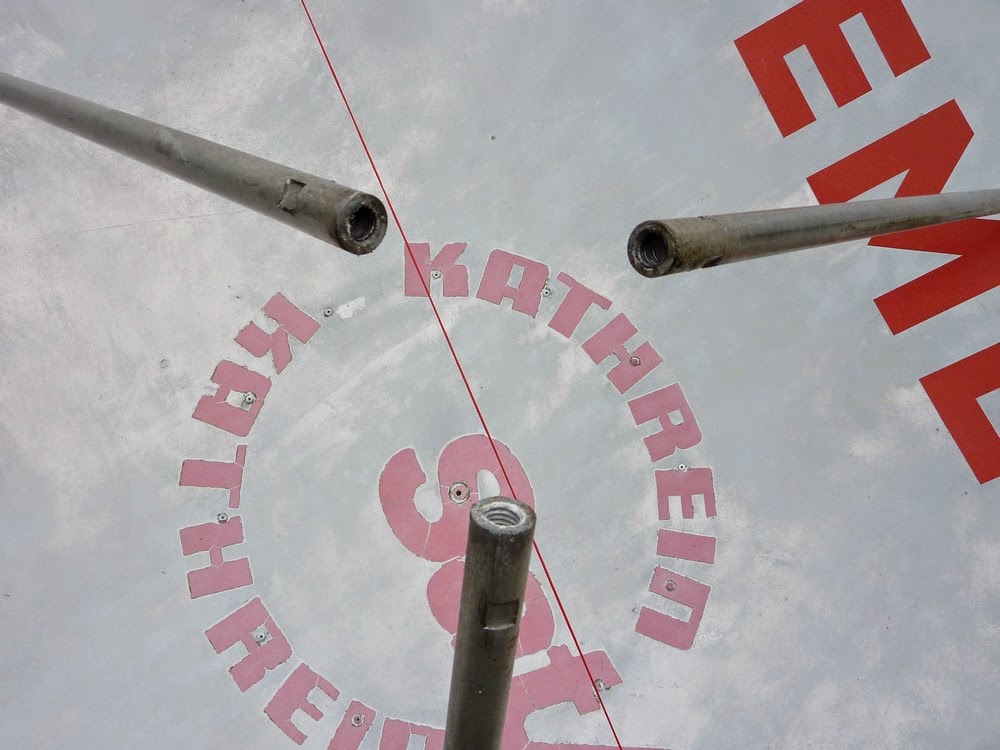
The thin red line is just a tightly stretched cord for measuring the depth of the dish.


The bare, protective feed hub still attached to the support arms.

Only two of the arm fixing screws are hollow to allow coaxial cable to run inside the lower, feed support arms.


Other Kathrein dishes had a heavy, aluminium, three-eared, centre boss instead of the cup and protective can.

Note the much smaller bores of the arm fixing screws compared with my own dish. Presumably from an earlier period when smaller coaxial cable was the standard.  


The protective, aluminium, feed cover is held in place on the bowl-shaped, feed boss with three socket head screws. It is made of aluminium with a coarse spray paint coating.

It is 22cm deep x 17.5cm in diameter.


The feedhorn and captive skew adjustment ring after decades of exposure to the weather.

There is no protection in the open end of the feedhorn to stop spiders entering. One spider was still living inside and there were lots of spider webs.

Modern LNBs usually have some sort of plastic screen to stop insect ingress.

The front diameter of the feedhorn which fits the large hole in the feed [bowl shaped ] boss is 63mm. The rear diameter is 60mm Ø. The skew clamping flange is 69.5mm Ø.


One of the hollow screws which clamp the feed support arms to the dish. The spanner size is 19mm. Once removed (with great difficulty!) a powdery white deposit was coating the threads. The rear screws are housed in a local dimple in the dish.


Inside the Kathrein LNB block machined from massive limps of solid aluminium alloy. The Vertical and Horizontal polarisation antennae are the small blades inside the machined housing. Modern LNBs use one wave guide leading to a pair of antennae at right angles to each other.


Another view inside the massive LNB showing part of the signal wave guide. All fixing screws are stainless steel.


The bare protective feed bowl/boss or hub from the inside.

Here the hub has been removed to show the female threads which hold the arm fixing screws. 17mm spanner/wrench flats are provided on the arms to resist torsion when fastening or loosening these fixing screws. The arms themselves are thick wall, large diameter aluminium alloy tube. I recommend that you grease the screw threads afterwards if you do manage to dismantle the hub or dish fixing screws.


I had a real struggle with one badly galled arm fixing thread. It was vital to be able to remove the cup/hub to allow conversion to a modern C120 LNB hub. Just as I did with the Salora dish.

The Kathrein hub/cup is for another standard than C120 and would be quite difficult to convert.


Click on any image for an enlargement. 
)

[P15] Kathrein 2.2m Dish parameters.

(

The Kathrein dish measures 220cm in diameter [D ] from edge to edge of the active concave surface.

The depth [d] to the centre of the dish, measured from a tightly stretched cord, is 40cm.

The front edge of the feedhorn throat, of the original LNB, is 75cm from the dish surface.

Theoretical focus is D^2 / 16d = 220 x 220 / 16 x 40 = 48400 / 640 = 75.6cm

Focal ratio = 75.6 / 220 cm = .34

Here is a fascinating 1986 Kathrein promotional video on YouTube:


[P14] Kathrein 2.2m Mounting.

(

Having cleaned the huge dish I now have to support it to point upwards at 25 degrees local altitude. I could have dug a meter-deep hole (3'3") and poured concrete around the 4" steel pole I had previously sourced. This would have provided an immovable support. Except that this was a problem in itself. The dish could not be easily moved if it was decided that the original site was unsuitable.

Hedges and trees can easily block the dish's view of the satellite without constant trimming. Conversely, the more exposed the situation the less shelter is available from the wind. The huge area of such a large dish can be caught by a storm with devastating effect. Horizontal forces on such a large area can be enormous. The dish must point south east to capture the weak signal from the satellite. Gales and storms usually blow in from the south to south west. The dish can catch the wind like an aerofoil under certain conditions. Further adding to the forces trying to topple it.

The original mounting support (seen in the image above) was a vertical stub of thick-wall, 114mm diameter x 30cm tall, steel pipe. This is welded to a 1.9m long, 80mm box-section steel beam.

The adjustable dish mounting itself rests on the 4" pipe and is clamped to it with two large U-bolts. Fine, vertical adjustment was provided by a screwed rod and lock nuts. This arrangement had survived for several decades of bad weather attached to the massive, lattice mast. The mounting was still in perfect condition if I wanted to re-use it. All I needed was to arrange the 114mm pipe of suitable height for the mounting to rest on.

An alternative arrangement would be to discard the original mounting. I could use the original, vertical pivots where they attached the dish's inner support ring to the mounting. This would require two sloping support bars set at 65 degrees spaced (at 63cm) to match these pivots. 65 degrees is the compliment of the desired 25 degrees altitude for the satellite dish to point at the Astra 2 satellite at 28E.

These sloping support bars would need to be strongly supported themselves. Probably by an A-frame arrangement. Though Kathrein show a tetrahedral stand being available for their dishes back in the mid-1980s. Even a dish mounted on a car trailer with a tetrahedral stand!

Here is a mock-up in slotted angle to judge the scale and rigidity of a tetrahedral stand. All members are 2m in length. (6'6") This would need considerable reinforcement to cope with any wind loading on a 2.2 metre dish. In fact it would probably sag under the weight of the dish itself! I had planned to use such a stand temporarily. Just to confirm that the new dish was going to give me improved signal strength over the present 1.8m Salora dish.

A tetrahedron is a pyramid with a triangular base. It offers the stiffest natural geometry of any simple solid since all sides are (undeformable) triangles. Using the vertical pivot eyes on the dish reinforcing ring would allow such a simple supporting stand.

The 2.2m Kathrein dish is now in place on the temporary, tetrahedral stand. The balance is perfect when the dish is supported by the pivot eyes. Only the lightest touch is necessary to increase or reduce the altitude pointing angle. I was able to use a length of cord to attach the original, fine vertical adjustment screw. Nothing stronger was needed just for reception testing purposes. Not that I intend to subject it to a gale. It is well sheltered in its present position and the forecast for falling wind speeds.

Mass loading of the base would help to keep the structure safely on the ground when a gale is blowing. This has the advantage of allowing the entire arrangement to be relatively easily re-sited if required. Removal of the ballast would allow the stand to be dragged. Or even rolled around the lawn with the addition of suitable wheels. Offering the chance for a clearer view of the sky. Or better shelter from the wind. The dish plus its bare mounting frame would be too heavy for one person to to lift but could still remain reasonably mobile. It is not just a case of building for survival in a storm but to avoid any rocking in a gale. The signal acceptance angle is very small on such a large dish. Any unwanted movement would result in the dish losing the satellite.  


Click on any image for an enlargement.
)

Saturday, 3 May 2014

Kathrein 2.2m dish

)

Removing the 4-way DiSEqC switch from the coaxial cable between the 6' Salora dish and the receiver had helped to extend the hours of reception slightly. Certainly better than having the switch in series. With much less audio hiccuping and picture break-up. Though it could still not be called reliable and no reception was possible in the evenings.

Then came the chance to obtain a redundant 2.2 meter Kathrein satellite dish. At 7'2" in diameter it had an extra 14" of aperture over the 6' (1.8m) Salora. Which offered an extra 2-3dB of theoretical gain over the 1.8m dish. [Kathrein claim 47dB gain in the Ku-band] Every extra dB is useful where fringe reception is concerned. +3 dB represents a doubling of signal strength.

The problem was getting the Kathrein dish down from a communal TV reception mast. The large and heavy dish was sitting at least 20' off the ground. The bottom of the mast was protected by plating around the exterior to combat unofficial climbers. The passing years had further provided a tall and dense growth of prickly hawthorn bushes! Climbing and using ropes was obviously not a very practical method of getting the big dish safely down to the ground.

Having obtained permission to remove the dish I hired a large cherry picker. Thus the task of lowering the dish (in the hydraulic platform cage) was quite easily accomplished. Thanks to the quality of the original U-clamps and a spray of penetrating oil, all the nuts came undone without too much difficulty. I had feared vertigo but working at that height from the sturdy, hydraulic platform was completely without drama.

The surface of the painted aluminium dish was disfigured by several decades of bird's muck. Birds would roost in the mast above the dish and drop what came naturally onto the dish below. Weathering must have helped to clean the dish over time. However, many dark and very rough stains spoilt the appearance of the dish and probably reduced its efficiency.

Using my recent experience with the Salora GRP dish I donned old clothes and waterproof, rubber gloves. Then I began to scrub with a fibrous, foam backed, pan scourer aided by domestic scouring cream. The cream quickly turned to a fawn colour. So something was certainly happening. The use of steel wool or similarly abrasive material would have removed the paint completely. Probably making the bare aluminium dish into a very efficient solar cooker! Not good for the poor little LNB at all! Pale coloured, matt paint is vital to the longevity of the LNB at the focus of such a large dish. The greater the collective area the more heat is concentrated at the focus. 

The dish remained in the trailer, for support, while I worked on the outer areas. Though I rotated the dish to bring a new area into easy reach I could not reach the central 3' of its diameter. So the dish had to be stood on edge, on the lawn, resting against the side of the trailer.

I always ensured that the dish material itself was not resting directly onto anything which might dent or damage it. Surface accuracy must be kept as original as possible. The reinforcing cage of alloy tubing was very useful in this regard. Nicely protecting the more fragile, spun aluminium parabola itself. 

A couple of hours later, after lots of rinsing, the dish now looks a lot cleaner. The mild abrasion had thinned the original paint slightly but the overall appearance was much improved. I think there is enough paint left to protect the LNB from burning. I will check with my hand at the focus when the dish is directly facing the sun.

The folding stepladder and wheelbarrow help to show the sheer scale of this even larger dish than the last. When standing in front of it the dish it seems to tower over me. I cannot reach the top with my arm fully outstretched even on tiptoe when the dish is vertical. Not without the aid of a beer crate to stand on. There is an interesting acoustic effect when I speak while standing in front of the dish. This is maximised at the centre of curvature. Which is twice the focal distance. Any sound made at this point is reflected right back to exactly the same point by the entire surface of the dish. The focus is where parallel electromagnetic waves, from a great distance, are reflected from the dish surface and brought to a point. Much as a concave mirror can act as a burning glass or a reflecting telescope functions.

The weight of the dish is only just manageable by one (fairly fit) person. Though a helper makes it much easier to move. Lifting the thing is still undesirable except for two fit men. Rolling it on edge (preferably on a soft lawn to protect it) is by far the easiest way to move it any distance. The rear, reinforcing cage is also handy for getting a secure grip on this huge, ungainly object.

The dish must not catch the wind or the lone worker could easily lose control. I worked behind a 6' thick 10' high conifer hedge so had no problems. The dish has a strong leaning back tendency due to the reinforcing cage and all of the dish material being literally behind the rim. So standing it vertically is very unlikely to cause it to flop over, face down. At least, not without the help of the wind.

Here I must thank my new found friend for his invaluable help in organising the entire proceedings. Without his contacts and vital diplomacy I would never have heard of, nor have been able to obtain this larger dish. He even helped me to remove the dish from the mast by adding useful muscle power. I shall not name him to protect his privacy and modesty. My grateful thanks for all his help.

In the next post I shall discuss alternative mounting arrangement for the bigger dish.

Click on any image for an enlargement.
(